


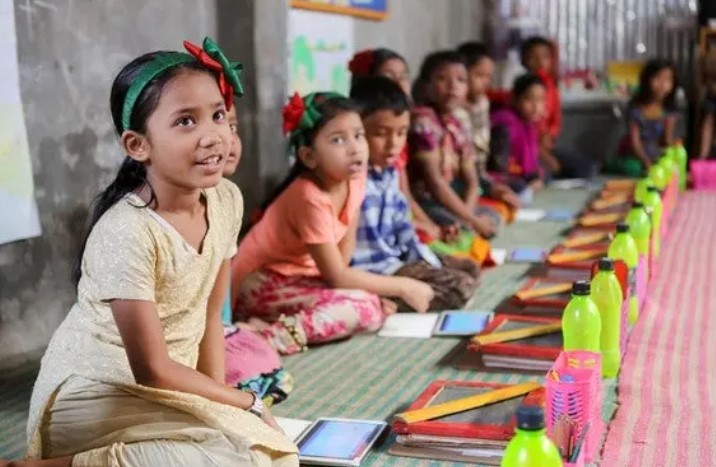
Bangladesh has done what many countries still struggle to do. It has enrolled girls in school and kept them ahead in education. Girls’ education is among the clearest development achievements of Bangladesh.
Girls outperform boys in the HSC pass rate, make up nearly half of public university graduates, and finish their degrees in large numbers every year. Yet the achievement stops short of the workplace.
Once the last examination is over, women’s participation in the labour force stays at about half the level of men’s, and many who try to enter meet a labour market with few openings and little room for them.
The gap has several sources, and they build on one another. A weak job market for graduates narrows the choices for everyone; women are underrepresented in technology and engineering; and graduates of non-science subjects face the highest unemployment.
Hiring practices, from male-dominated interview boards to questions about marital status, screen many out before their qualifications are read, and limited access to credit closes off the option of starting a business.
Marriage and family expectations then arrive at the point where a career would begin, and the unpaid care work that follows leaves little time or support for paid employment.
Two of these weigh most heavily in the evidence: a labour market with too few jobs for graduates, and a care burden that falls almost entirely on women. Together they turn one of the country’s most visible successes into one of its least used resources.
The girls who lead: In the 2025 HSC and equivalent examinations, the education boards reported a pass rate of 62.97 per cent for girls and 54.60 per cent for boys, and girls also collected more of the top GPA-5 grades.
Government data show that women made up 47 per cent of public university graduates in 2023, up from 14 per cent in 1973.
After the last exam: Results day ends. The sweets are finished, the certificates are framed, and the job search begins. That is where the numbers change sides.
Applications go out to big companies, then smaller ones, then to anyone who will reply. The replies slow down and then stop, and the polite answer to relatives, ‘looking’, starts to sound like an excuse.
The Bangladesh Bureau of Statistics (BBS) found in its first quarter 2024 Labour Force Survey that 80.58 per cent of men were in the labour force, compared with 40.89 per cent of women.Bangladesh market report
Among graduates, the BBS Labour Force Survey 2024 recorded unemployment of 20.39 per cent for women and 11.31 per cent for men.
The civil service follows the same curve. The Public Service Commission’s 2023 annual report shows only 421 women among the 2,163 candidates recommended in the 43rd BCS, or 19.46 per cent.
Earlier exams gave women about a quarter of the places.
A shrinking job market: Graduate unemployment reached 13.5 per cent in 2024, according to the BBS Labour Force Survey. The reason is that the economy has not created enough jobs for the educated youth it produces.
The labour force itself shrank in 2024 for the first time since 2010, and women made up most of the drop. At a January 2026 dialogue, analysts linked a fall in urban female participation from 25.1 to 22.5 per cent to shrinking factory jobs and automation in the garment industry.
Degrees that point elsewhere: Women also cluster in particular fields. A 2026 study of women’s participation in STEM at Bangladeshi universities found women make up more than 60 per cent of enrolment in health-related programmes but under 26 per cent in engineering and technology. A 2018 Daffodil International University survey found women were 16 per cent of the ICT workforce.Bangladesh market report
In teaching, GIZ’s 2025 report shows women hold more than 60 per cent of primary posts but under 30 per cent of post-primary posts. The higher the classroom, the fewer women stand at the front.
A Bangladesh Institute of Development Studies study of National University college graduates found unemployment of 34.31 per cent among women against 19.96 per cent among men, with graduates of non-science subjects hit hardest.
Hiring adds its own filter. A Dhaka University study of unemployed educated women, based on interviews with graduates and employers, found interview boards dominated by men, discrimination based on marital status and too much attention to appearance.
Starting a business is the usual alternative, but Bangladesh Bank data cited in an a2i report show women received under 4.0 per cent of small and medium enterprise loans, a share that has stayed below that level since 2010 against a policy target of 15 per cent by 2024. Collateral is the main obstacle women name.
Marriage and the second shift: Family decisions run through all of this. An IZA study on young women in Bangladesh found that expectations about what fathers, or husbands in the case of married women, think of women working strongly shape the support they receive for taking jobs.Bangladesh market report
Marriage is where that influence becomes concrete. Nearly half of girls still marry before 18, according to the Multiple Indicator Cluster Survey 2025 by the BBS and UNICEF, which puts the figure at 47 per cent, and for them education usually ends before a degree is within reach.
For those who do graduate, marriage tends to fall in the same years as the job search, and their marital status often counts against them in interviews.
The work that follows marriage is what keeps many women out. The Time Use Survey 2021, carried out by the BBS with UN Women, found that women spend 4.6 hours a day on unpaid domestic work and 1.2 hours on unpaid care, against 0.6 and 0.2 hours for men.
A BRAC survey found that about 75 per cent of women who leave work name family responsibilities and motherhood as the main reason, and many struggle to return.
A woman does not need to be forbidden from working. A kitchen, a child and a long ride home in a crowded bus can do the job by themselves. Workplaces with no childcare, fixed hours and unsafe roads finish it.
A chair waiting: The distance between what Bangladeshi women achieve in education and what they can do with it is a problem of design, and design can be changed. Bangladesh market report
Reversing the pattern calls for measures well within reach: transport women can trust, childcare at workplaces, flexible hours, mentors in fields dominated by men, loans that do not depend on land titles, and degrees chosen with the job market in mind.
Universities can start by linking final-year students with employers, and employers can start by retiring interview questions about marriage plans.
Bangladesh has shown that it can get girls to the top of the merit list. The harder test has no results day. It asks whether there will be a chair waiting when she walks out of the exam hall with her certificate in hand.