


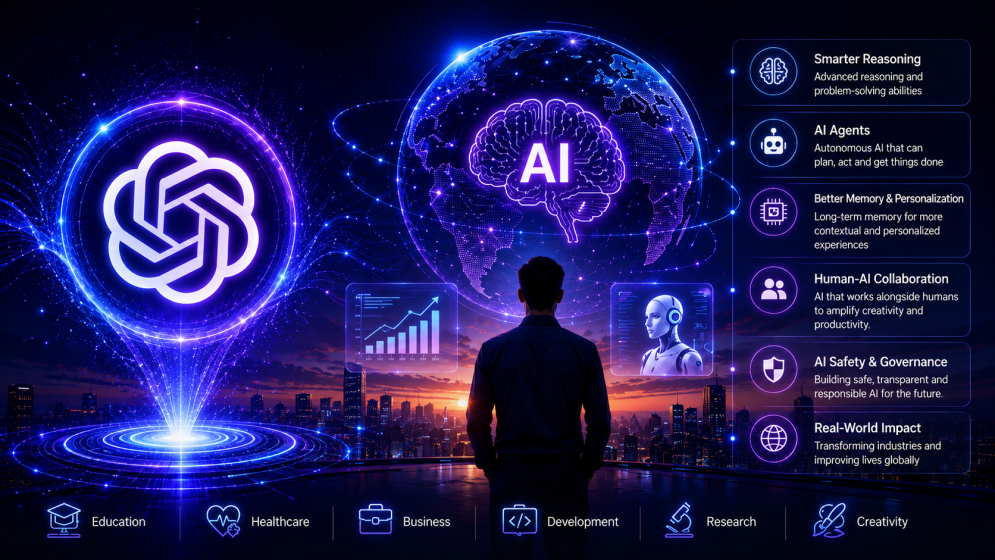
Artificial intelligence has evolved rapidly over the past few years, transforming from a research-driven technology into a powerful tool used by millions of people worldwide. As AI systems become more capable and integrated into everyday life, discussions are increasingly turning toward the next chapter of innovation and what future AI may look like.
ChatGPT-6 has become a focal point in these discussions because it represents broader expectations about the future of artificial intelligence. While the exact capabilities of future AI systems continue to evolve, current trends suggest that upcoming models may become more intelligent, context-aware, efficient, and useful across a wider range of real-world applications.
This article explores the technologies, opportunities, and challenges that could shape the future of artificial intelligence and why ChatGPT-6 has become an important part of that conversation.
A New Era of Artificial Intelligence
The evolution from GPT-3.5 to modern multimodal AI systems has already demonstrated how quickly artificial intelligence can improve.
Today’s AI models can:
Understand and generate text
Analyze images
Process documents
Engage in voice conversations
Assist with coding and research
Support business and productivity workflows
These capabilities were considered highly advanced only a few years ago.
The next generation of AI is expected to build upon these foundations and expand them further.
One of the most anticipated developments in future AI systems is stronger reasoning.
While current AI models can already analyze information and assist with complex tasks, future systems may become significantly better at:
Multi-step problem solving
Strategic planning
Scientific analysis
Technical research
Decision support
Improved reasoning could allow AI to provide more accurate, reliable, and context-aware assistance across professional and academic fields.
Rather than simply generating responses, future AI may become increasingly capable of helping users think through complex challenges.
The Rise of AI Agents
One of the most discussed concepts in artificial intelligence today is the emergence of AI agents.
Unlike traditional chatbots that primarily answer questions, AI agents are designed to complete tasks, manage workflows, and perform actions on behalf of users.
Examples may include:
Researching information across multiple sources
Organizing projects
Managing schedules
Generating reports
Automating repetitive digital tasks
This shift could transform AI from a conversational assistant into a more active digital collaborator.
For businesses and professionals, agent-based systems may significantly improve efficiency and productivity.
Memory is expected to play a major role in the future of artificial intelligence.
Early AI systems often treated each conversation as a separate interaction. Future systems may become increasingly capable of maintaining context, understanding user preferences, and delivering more personalized experiences.
Potential benefits include:
More relevant recommendations
Improved workflow continuity
Better contextual understanding
Reduced repetition during conversations
The goal is not simply remembering information but using context effectively to provide more useful assistance.
Human-AI Collaboration
The future of artificial intelligence is unlikely to be defined by humans versus machines.
Instead, many experts believe the most impactful developments will come from collaboration between people and AI systems.
In this model:
Humans provide judgment and oversight
AI provides speed and analytical support
Decisions remain human-led
Productivity increases through collaboration
This approach allows individuals and organizations to benefit from AI capabilities while maintaining control over important decisions.
The strongest outcomes are likely to emerge when human expertise and artificial intelligence complement each other. The development of multimodal AI has already changed how users interact with technology.
Future systems may become even better at understanding and combining information from:
Text
Images
Audio
Video
Documents
Real-world environments
This could create more natural and intuitive interactions between humans and machines.
Instead of switching between different tools, users may increasingly rely on a single AI system capable of understanding multiple forms of information simultaneously.